


Romanesque Cellar
tel. 508 816 502, e-mail: piwnicaromanska@archeologia.pl
Branch video
Highlights
- Podziemia klasztorne z XIII wieku – najstarsze wnętrze do zwiedzania w całym Gdańsku.
- Ossuarium (ściana kości) z XVI/XVII wieku.
- Znaleziska i odkrycia archeologiczne.
Permanent exhibitions
Temporary exhibitions
- Aktualnie nie ma wystawy czasowej.
Opening hours
- Open Tuesday to Sunday, 10:00–17:00. Closed on Mondays.
- Visits start every 30 minutes, in groups of up to 10 people.
- Last admission is half an hour before closing.
Opening hours — detailed information
Public holidays in 2026
- 1 January (New Year’s Day, Thursday) – closed
- 6 January (Epiphany, Tuesday) – closed
- 4 April (Holy Saturday) – open from 9:00 to 14:00
- 5 April (Easter Sunday) – closed
- 6 April (Easter Monday) – closed
- 1 May (Labour Day, Friday) – open from 10:00 to 17:00
- 3 May (Constitution Day, Sunday) – open from 10:00 to 17:00
- 17 May (Sunday after European Museum Night) – closed
- 24 May (Pentecost, Sunday) – closed
- 4 June (Corpus Christi, Thursday) – closed
- 15 August (Polish Armed Forces Day and Assumption Day, Saturday) – open from 10:00 to 17:00
- 1 November (All Saints’ Day, Sunday) – closed
- 11 November (National Independence Day, Wednesday) – closed
- 24 December (Christmas Eve, Thursday) – closed
- 25 December (Christmas Day, Friday) – closed
- 26 December (Boxing Day, Saturday) – closed
- 31 December (New Year’s Eve, Thursday) – closed
Ticket prices
- standard10 zł
- reduced7 zł
- family, up to 5 people (2 adults and 1–3 children)26 zł
- Admission is free on Sundays.
Concessions
- The Metropolitan Culture Card entitles its holder to reduced admission.
- The Tourist Card with the “Odkrywca” or “Odkrywca Premium” package entitles its holder to free admission.
- Do you have a Gdańsk Resident Card? Check your benefits at jestemzgdanska.pl
- The Large Family Card entitles its holder to reduced admission.
- The EURO26 European Youth Card entitles its holder to reduced admission.
- The museum supports the Dawcom w Darze initiative: an Honorary Blood Donor card entitles its holder to reduced admission.
- Please present the appropriate documents to claim reduced or free admission.
Reduced admission is available to
- primary and secondary school pupils, students at teacher training institutions, social service workers, university students and doctoral students who are citizens of European Union member states,
- people aged over 65, pensioners, disability pension recipients, and people with disabilities together with their carers, who are citizens of European Union member states,
- teachers at primary and secondary schools and universities, and teachers and educators at educational institutions, correctional facilities, juvenile shelters and diagnostic and consultation centres operating in European Union member states,
- war veterans.
Free admission is available to
- children under seven,
- licensed guides, tour leaders and teachers supervising organised groups,
- holders of the Order of the White Eagle, the Order of Merit of the Republic of Poland, the honorary badge “Meritorious for Polish Culture”, or the honorary title “Meritorious for National Culture”,
- staff of museums entered in the State Register of Museums and members of the Polish Museum Association, the International Council of Museums (ICOM) or the International Council on Monuments and Sites (ICOMOS),
- members of the Association of Polish Archaeologists, the Polish Historical Society or the Association of Art Historians,
- archaeologists, historians and art historians employed by state universities or the Polish Academy of Sciences.
Getting here
Tramwaj: linie 2, 3, 6, 7, 8 i 11 – przystanek Brama Wyżynna 02, ok. 7 min spacerem.
Pociąg, SKM: ze stacji Gdańsk Główny (PKP) ok. 20 min spacerem.
Accessibility
OBSZAR PORUSZANIA SIĘ
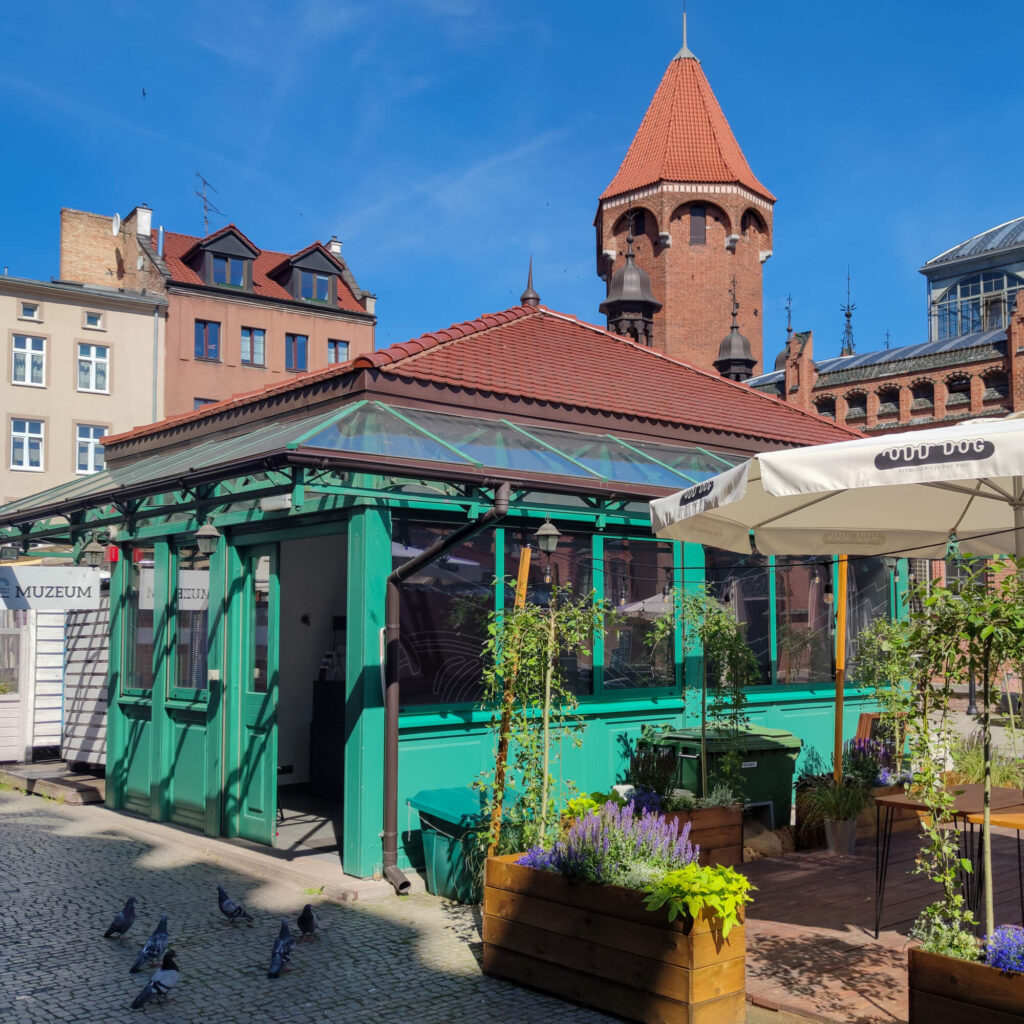
Wejście znajduje się na Placu Dominikańskim, przy Hali Targowej, nieopodal ceglanego ogrodzenia bazyliki św. Mikołaja. Do Piwnicy wchodzi się przez zielony pawilon oznaczony szyldem. Następnie schodzi się do podziemi. Wyjście znajduje się w drugim pawilonie, do którego prowadzi trasa podziemna.
W budynku nie ma windy. Na trasie zwiedzania są wielostopniowe schody, pomosty i wąskie przejścia. Wystawa jest niedostępna dla osób poruszających się na wózkach.
W muzeum znajdują się krzesła, na których można odpocząć.
Parking
Miejsca postojowe dla osób z niepełnosprawnością znajdują się w pasie ul. Pańskiej.
Toalety
W budynku nie ma toalet dla zwiedzających.
OBSZAR CZUCIA
Zwiedzanie części ekspozycji odbywa się w formie spektaklu audiowizualnego. Poszczególne detale architektoniczne, w miarę przesuwania się zwiedzających, są podświetlane specjalnie zaprojektowanym kolorowym oświetleniem i opatrzone komentarzem lektora.
OBSZAR WIDZENIA
W muzeum nie ma pasów naprowadzających na podłodze.
OBSZAR SŁYSZENIA
Wystawy można zwiedzić z tłumaczem PJM. Prosimy o zgłoszenie takiej potrzeby z co najmniej kilkudniowym wyprzedzeniem. Skontaktuj się z koordynatorką ds. dostępności: Monika Jodczyk, e-mail: m.jodczyk@archeologia.pl, tel. (+48) 508 008 361.
W muzeum nie ma pętli indukcyjnej.
Pies przewodnik
Zapraszamy osoby z niepełnosprawnościami z psami przewodnikami i psami asystującymi.
UDOGODNIENIA DLA OPIEKUNÓW Z DZIEĆMI
Brak udogodnień dla opiekunów z małymi dziećmi. W budynku brak miejsca, gdzie można by zostawić wózek dziecięcy na czas zwiedzania.
Shop
Na parterze, przy kasie znajduje się sklepik muzealny, gdzie można kupić bilety wstępu do muzeum.
Szatnia
W muzeum nie ma szatni.
Treści wrażliwe
W muzeum znajduje się ossuarium, gdzie są przechowywane kości dawnych mieszkańców Gdańska. Ossuarium jest częściowo osłonięte i udostępnione zwiedzającym w jednym z bocznych pomieszczeń.
Guided tours
A multimedia guide is included in a standard visit. Recorded narration and accompanying lighting effects take visitors through all the rooms, step by step.
Visitors may ask for the multimedia to be switched off to explore in silence and with normal lighting. Please tell a member of staff before your visit begins.
School groups
Przyjmujemy klasy ze szkół podstawowych i ponadpodstawowych. Termin trzeba zarezerwować z co najmniej dwutygodniowym wyprzedzeniem. Komplet informacji podajemy w zakładce EDUKACJA.
The origins of the Romanesque Cellar
The Romanesque Cellar is a surviving part of the 13th-century Dominican monastery. 800 years ago, this room served as the friars’ refectory: a kitchen and dining room.
The cellars were discovered in 2005/2006 during excavations in Dominican Square by the Archaeological Museum in Gdańsk.
The site opened to visitors on 30 December 2014.
W trakcie badań archeologicznych prowadzonych w latach 2001–2013 na terenie dawnego dominikańskiego zespołu kościelno-klasztornego (1227–1813 r.) odkryto kilka ossuariów, czyli miejsc wtórnego złożenia szczątków ludzkich. Pochodziły one z różnych okresów, od późnego średniowiecza (XV wiek) aż do XIX wieku. Opisaliśmy je w artykule: Nowożytne ossuaria z klasztoru dominikańskiego w Gdańsku.